



You know the scene. A candle spikes on your chart, a Telegram channel lights up, and before you finish the thought, your finger is on Buy. No stop loss. No position size. No idea that a major US data release lands in twenty minutes. An hour later the trade is red and you are asking yourself what just happened.
That is rarely a strategy problem. It is a psychology problem, and almost every new trader meets it. This post explains why the urge to click first and think later is so strong, what it quietly costs you, and the short routine that puts a pause between the impulse and the order.
Why New Traders Trade on Impulse
Trading psychology is simply the study of how emotions and mental shortcuts steer your decisions. Education sites from TradingView authors to broker academies keep naming the same four traps:
- FOMO (fear of missing out). Price is moving and you are not in it. Entering feels urgent, so you chase the move, skip your setup and often skip the stop loss too. Social media makes it worse, because you only ever see the winners posting screenshots.
- Revenge trading. After a loss, the need to win it back takes over. The usual pattern is a bigger position, a rushed setup and a stop that is either missing or far too wide.
- Overconfidence after wins. A few green trades make you feel you have the market figured out, so size creeps up and the rules start to slide.
- Greed and boredom. Wanting more, or just wanting action, pushes you into low-quality trades that your plan would never have approved.
Under all four sits the same mechanism: a fast emotional reaction fires before the slow, analytical part of your brain gets a vote. Nothing is wrong with you. Markets move quickly, screens flash red and green, and a single click puts real money at stake. Without a process, the emotional brain wins by default.
What Impulse Trading Really Costs
Most retail leveraged traders lose money, and regulators make brokers say so. In Europe and the UK, brokers must publish the share of their retail CFD accounts that lost money over the past 12 months. IC Markets showed 73.42% as of 30 September 2026, and a March 2026 report on five major UK brokers found loss rates from about 68% up to more than 81%. The UK regulator, the FCA, has said roughly 80% of CFD customers lose money.
Treat those numbers as context, not a verdict. They are not your personal odds: whether you win depends on your knowledge, your risk management and the market. But they show how much the average beginner leaves on the table, and impulse entries are a large part of it.
Impulse trades hurt in three ways:
- Undefined risk. If you never decided where you are wrong, the market decides for you, usually at the worst price.
- Oversized positions. Fast, emotional entries tend to be bigger than a calm plan would allow, and leverage multiplies the damage.
- Hard-to-recover losses. Losses compound against you, because the gain needed to get back to even grows faster than the loss itself.
| Loss on your account | Gain needed to break even |
|---|---|
| 10% | 11.1% |
| 20% | 25% |
| 30% | 42.9% |
| 50% | 100% |
One revenge trade that loses 30% is not a bad day. It is a 43% climb back to where you started.
Four Checks Before Every Order
The cure for impulse is not willpower. It is a short list of questions you must answer before the order ticket opens. Four cover most of what a beginner needs.
| Check | Question to answer first | Where to look |
|---|---|---|
| Risk | How much do I lose if my stop is hit, and is that small enough? | Position-size calculator or your platform’s risk tool |
| Trend | Is price trending or ranging on a higher timeframe, and am I trading with it? | TradingView charts on the daily and 4-hour |
| Economic data | Is a high-impact release due soon? | Forex Factory economic calendar |
| Technical levels | Where are support and resistance, and where does my idea become wrong? | TradingView chart, marked before entry |
Risk comes first. Many educators suggest risking only 1–2% of your account on a single trade. Once you know your stop distance, the position size follows:

On a $1,000 account risking 1%, the most you accept losing is $10. Convert the result into lots or units with your platform’s calculator.
Check the calendar next. Forex Factory rates scheduled releases by expected impact, usually colour-coded, so a red event such as US Non-Farm Payrolls stands out. Spreads can widen and prices can jump around these releases. Many beginners simply stay out, or cut size sharply, for a window of roughly 15 to 30 minutes either side.
Then read the chart. Trade with the higher-timeframe trend until you have a reason not to, and mark your levels before you look at the order button. If you cannot point to the level that proves you wrong, you do not yet have a trade.
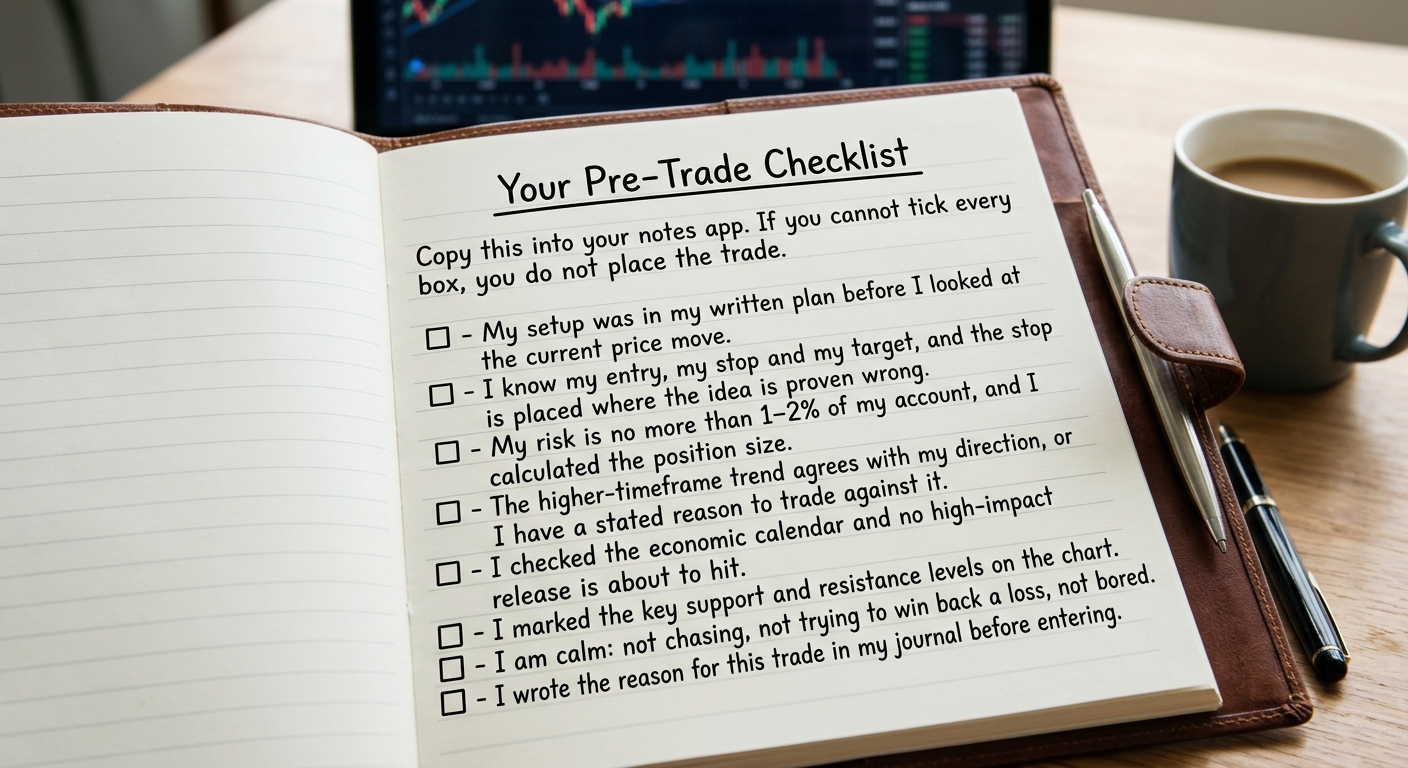
Pre-Trade Checklist
Photography is one of the best ways to capture fleeting everyday beauty. Even a walk through a quiet street can reveal colors, patterns, and perspectives worth remembering. The trick is not to wait for something extraordinary, but to find meaning in the ordinary.
Building the Discipline Habit
A checklist only works if you keep using it. These habits make that easier.
- Keep a trading journal. Record the pair or instrument, entry, stop, target, result and, most importantly, how you felt. Tag impulsive entries as such. After a few weeks the pattern is hard to ignore.
- Track your numbers. Tools such as Myfxbook can connect to your account and show your history, drawdown and goals, so you judge yourself on data rather than memory.
- Practise on a demo first. Run your checklist for a few weeks with no real money at stake, until following it feels automatic.
- Set a daily loss limit. When you hit it, close the platform. This is the most direct defense against revenge trading.
- Add a waiting rule. After any loss, step away for a set time before the next trade. A short pause is often enough to let the urge pass.
- Keep learning. Books such as Mark Douglas’s Trading in the Zone are a popular starting point for the mental side of trading.
The goal is not to remove emotion. It is to make sure emotion never gets to place the order alone.
The Takeaway
The market will always offer another candle, another headline and another reason to hurry. Surviving as a new trader mostly means refusing to hurry. Calculate the risk, read the trend, check the calendar, mark your levels, then decide.
Before your next order, run the checklist above. If it saves you from one impulsive trade, it has already paid for itself.
This article is educational and is not financial advice. Trading leveraged products such as forex and CFDs carries a high risk of losing money. Only trade with money you can afford to lose.